Shopery B2B SaaS

Product Design
Project Overview
Shopery SaaS empowers industrial groups to streamline their procurement processes, driving competition among suppliers and enhancing efficiency.

With our Shopery, businesses can:
Optimize and centralize procurement operations.
Reduce costs by increasing supplier competition.
Connect a global supplier network for better sourcing opportunities.A smarter, more efficient way to manage industrial procurement.
My Contributions
As solely Product Designer in Shopery, I played a key role in defining the product vision, prioritization, and scope, ensuring alignment with both business objectives and customer needs. I collaborated closely with a cross-functional team to create a scalable and client-agnostic procurement solution while addressing complex user challenges.

My responsibilities included:

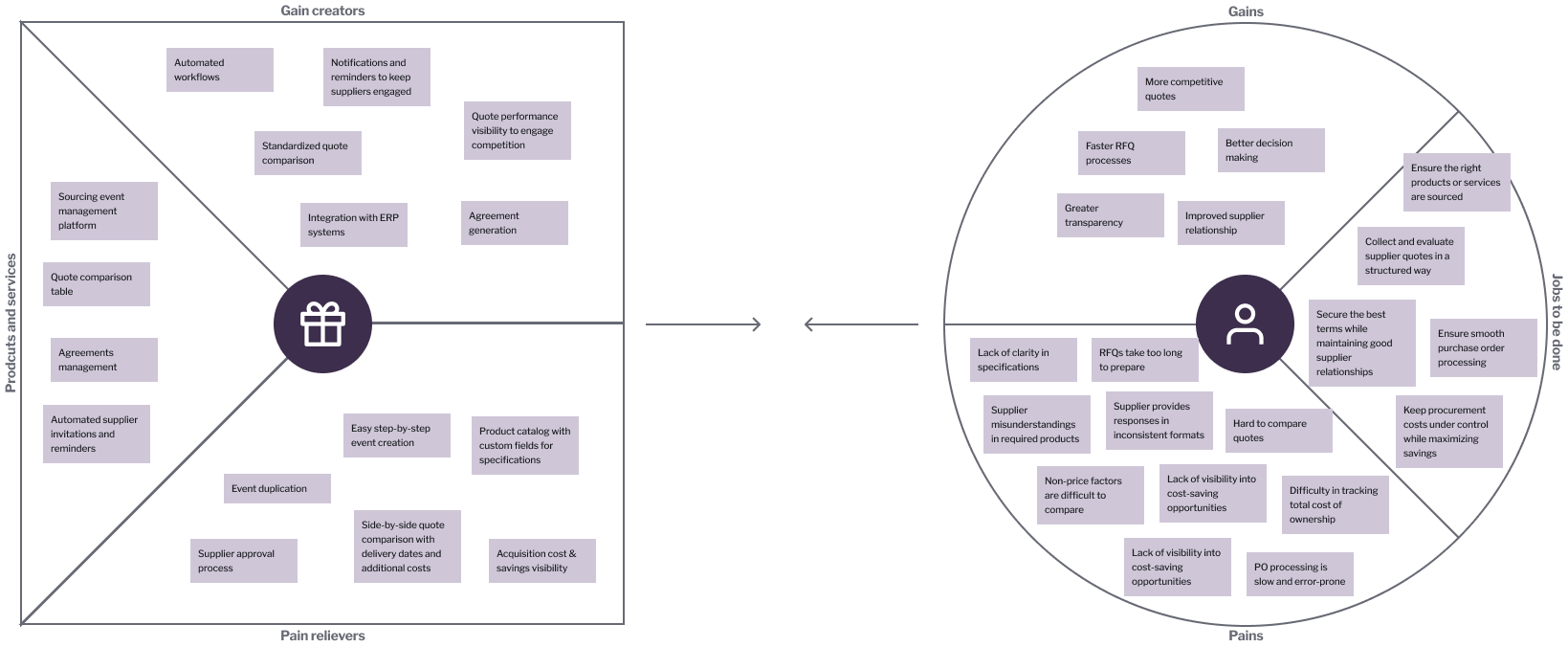
Leading interviews with client-side procurement teams and their suppliers to uncover motivations, jobs to be done, and pain points from both perspectives.
Conducting deep analysis of industry workflows, best practices, and system requirements.
Designing and prototyping the entire buyer and supplier journeys, ensuring clarity, consistency, and scalability.
Design systems management, ensuring consistency and scalability across the platform.
Collaborating closely with developers and stakeholders to align business, design, and technical decisions.
Shopery
Principal Product Designer
Mar 2016 - Apr 2025

The Challenge

This project represented a major transformation. Originally conceived as an eCommerce platform, Shopery had to pivot into the Enterprise Procurement space — a field with highly complex workflows, strict compliance requirements, and demanding corporate users on both the buyer and supplier sides.

This shift required not just a new interface, but a deep understanding of procurement as a business domain: its motivations, its friction points, and the nuances that differentiate it from traditional eCommerce.

Objectives

Our goal was to position Shopery as a user-friendly, accessible alternative to SAP Ariba, a legacy procurement tool known for its rigidity and steep learning curve.

Beyond improving usability, the product aimed to:
  • Reduce the time required to create and manage procurement events.
  • Offer more flexible and competitive event models beyond traditional RFQs.
  • Build a scalable foundation for enterprise-grade workflows and integrations.

Process

The process began with an extensive discovery phase, where we mapped how enterprise procurement actually happens — from event creation to supplier negotiation and contract management.Through weekly stakeholder sessions and qualitative research, we identified key inefficiencies and opportunities to simplify workflows without losing functional depth.

I led a series of interviews and contextual inquiries with both procurement teams and suppliers to understand their expectations, frustrations, and behavioral patterns.
These insights directly shaped our design principles: clarity, control, and collaboration.

During the early exploration, I produced dozens of diagrams and system maps to visualize workflows, dependencies, and data flows between user roles. These visualizations were critical to align product, design, and engineering on how procurement truly worked.

As the design evolved, we transitioned into detailed prototyping.
I managed a large number of FigJam and Figma files where we:

  • Mapped each functionality with technical definitions and workflow diagrams.
  • Created interactive prototypes to validate process logic and user interactions.
  • Documented UI patterns and interaction rules to build the foundation for a new design system adapted to enterprise workflows.

This hybrid approach — designing while still discovering — allowed us to uncover gaps early, avoiding costly reworks during development and ensuring that each iteration was grounded in real user needs.

Key Challenges

Building new components and layouts was part of the work, but the biggest challenge was translating the business complexity of procurement into something usable, intuitive, and scalable.

We had to support workflows that could stretch across multiple weeks, involve dozens of stakeholders, and contain several layers of decision-making, all without overwhelming the user.

To achieve that:

  • We designed a flexible role and permission system that allowed different user types — buyers, approvers, and suppliers — to participate in the process according to their responsibilities. Each role had specific access levels for event creation, validation, and monitoring, ensuring security and transparency across the organization.
  • We implemented progressive disclosure patterns to keep interfaces clean while still allowing advanced users to access deeper layers of functionality.
  • We designed autosaving, multi-step forms to safely handle long and intricate workflows.
  • We developed dense monitoring views capable of displaying real-time updates and large data volumes without sacrificing clarity.
  • We refined typography, spacing, and hierarchy to make number-heavy screens more readable and actionable.

  • Through continuous validation with stakeholders and iterative prototyping, we managed to balance flexibility and simplicity — two qualities rarely found together in enterprise tools.

    Results

    • Adopted by a major enterprise – Shopery is now used weekly by the 4th largest meat producer in North America.
    • Significant time savings – Procurement event management is 60% faster compared to SAP Ariba.
    • Increased efficiency – The procurement team reduced its full-time equivalent (FTE) workload from 5 to 1, optimizing resource allocation.
    • Cost savings – Achieved an average savings of 14% on procurement events.
    • High transaction volume – Facilitated $35M in procurement agreements within the first 6 months.

    These results highlight Shopery’s impact as a fast, efficient, and cost-effective alternative for enterprise procurement teams.

    Reflection

    This project taught me that designing for enterprise is less about screens and more about systems — understanding motivations, constraints, and business logic deeply enough to turn complexity into clarity.

    By combining strategy, research, and detailed UI execution, we transformed Shopery into a procurement platform that’s not just functional, but genuinely empowering for its users.

    Special thanks to all the Shopery team.